Future-Proofing the Future Work – From Words to Action
A multi-uncertain world, an AI revolution, and recurring crises are shifting the rules of the game. Organisations that fail to keep an eye on the future risk falling behind. But how do successful organisations actually work with future-related issues today? And what will it take to succeed tomorrow?
Recent years have shown that the future is no longer a distant horizon saved for annual strategy retreats. The pandemic, the climate crisis, geopolitical turbulence, and the rise of AI have forced leadership teams to recognise that futures work is no longer a nice-to-have – it is survival. Today, dedicated foresight units are being built with direct links to top management, new methods are emerging, and entire industries are rethinking their relationship to what lies ahead. Research is also clear: a strong future orientation pays off. Organisations with at least a five-year time horizon and systematically implemented foresight in their innovation work exhibit on average 33% higher profitability and nearly 200% higher stock market value growth. The key is a combination of long-term vision and operational discipline.
A New Era for Foresight Work
During the 2020s, the baseline for Swedish organisations has shifted markedly. A Kairos Future survey in spring 2025, involving over 430 leaders and strategists, shows that nearly two-thirds believe external factors now determine their organisation’s direction, while only 20% feel they steer development themselves. Before the pandemic, the numbers were reversed.
At the same time, the survey reveals that only about 30% of organisations have a clear strategic process for forward-looking environmental scanning. Nearly half lack structure altogether and work ad hoc, driven by individual enthusiasts. Many organisations are also fully occupied with managing the present, leaving little room for long-term thinking — despite the fact that lifting the gaze beyond the uncertain now is more critical than ever. In other words, there is an enormous underutilised potential for better futures work in Sweden today.
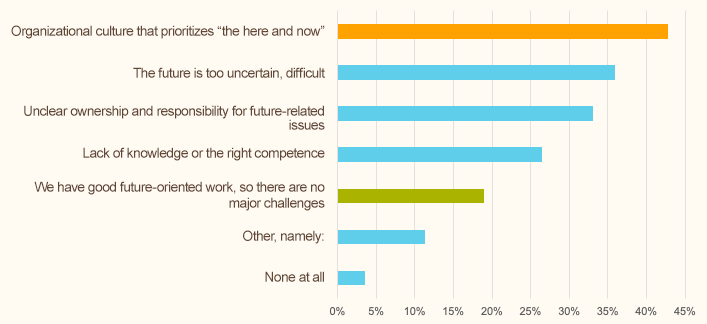
Figure 11. What is the biggest obstacle to getting the management in your organization to invest in long-term future work, according to 430 Swedish leaders and strategists? Source: Kairos Future 2025.
From Forecasting to Navigating Uncertainty
Traditionally, futures work has centred on forecasting – attempting to predict the most likely future as precisely as possible. Those days are over. In a world where uncertainty is the new normal, organisations must learn to work with multiple futures simultaneously. In general, three types of futures need to be balanced:
1. Predictable futures – forecasts based on established trends
2. Uncertain futures – alternative scenarios and critical uncertainties that can alter the rules of the game
3. Desirable futures – visions and goals that provide direction and confidence
More and more organisations are realising the need to work actively with all three. Scenario planning, war gaming, and strategic foresight are among the methods gaining ground. The latter, in particular, has grown significantly in recent years — in the public sector mostly as method exploration, and in the private sector as a more action-oriented discipline focused on turning insight into execution.
The Four Core Roles of the Futures Practitioner
To succeed in this new context, futures practitioners must master four distinct roles — and know when to apply each.
1. The Futurographer
Maps, analyses, and visualises how the future might unfold (traditional horizon scanning).
2. The Futurologist
Commands a broad toolbox of methods to understand, shape, and navigate the future.
3. The Futurosofer
Places present and future in perspective and challenges conventional truths — the modern court jester.
4. The Futuropeut
Guides the organisation forward in a concrete, pragmatic way. A change leader driven by future-thinking.
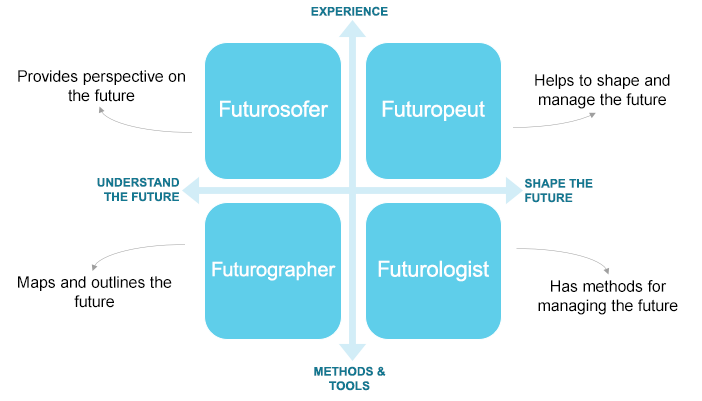
The four roles of the futures practitioner. Source: Kairos Future
Historically, most organisations have focused on the first two roles. But going forward, the futurosofer and the futuropeut — the advisor and the change leader — will be just as important. The shift is from mapmakers to pragmatic navigators.
Three Conclusions for the Future of Futures Work
1. From Analyst to Navigator
AI will automate large parts of traditional analysis work. The critical capability becomes translating insights into practical change. Futures practitioners who fail to strengthen their ability to handle complexity and drive change risk becoming irrelevant.
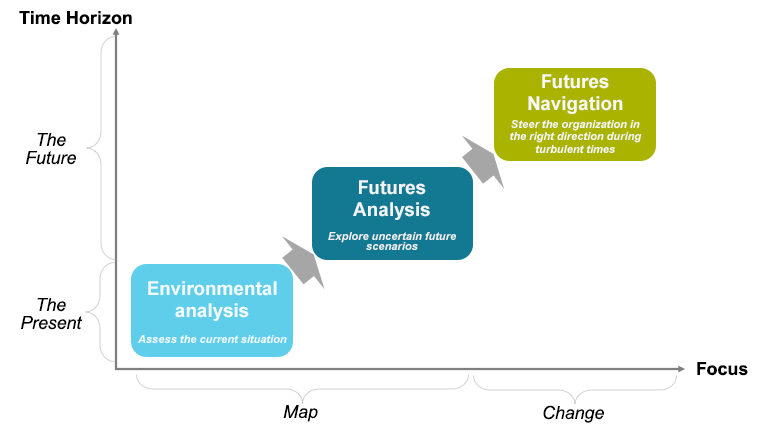
From environmental analyst to futures navigator
2. From Reactive and Static to Dynamic and Visionary Futures Management
Forecasts alone will not build future-resilient organisations. The real competitive edge lies in the ability to secure long-term direction. Organisations that combine clear visions with systematic foresight are three times more successful than those that lack this capacity, according to Professor René Rohrbeck at EDHEC Business School. Success increasingly depends on asking “Could it become this way?” rather than insisting “This is how it will be.”
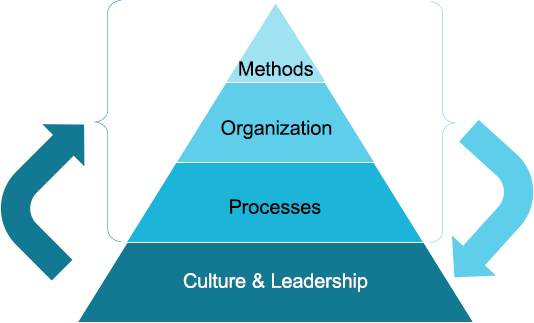
3. From Methods to Culture
Methods, tools, and processes have long been central to effective futures work — but they are no longer enough. The most important success factor today is cultivating a future-curious and psychologically safe culture. This, in turn, requires committed leadership from the top and strong internal process champions.
Do You Want to Strengthen Your Futures Work?
For 30 years, Kairos Future has developed research-based methods and tools for organisations wanting to look ahead with confidence. We help organisations build systematic environmental scanning, craft robust strategies for uncertain times, and strengthen leadership teams’ ability to navigate complexity. Explore how we have worked with others or contact us to discuss how we can support your futures journey. You are also warmly welcome to join a course in our Kairos Future Academy.